Most leaders don’t break because they lack discipline.
They break because the load they’re carrying quietly exceeds what their system can sustain.
At first, it works.
More decisions. More responsibility. More pressure.
Then something shifts.
You start to notice:
less clarity than you used to have
decision fatigue creeping in
a pace that no longer feels sustainable
pressure showing up outside of work
You work longer.
You hire more people.
You push for better execution.
But the pressure doesn’t actually go down.
It keeps finding its way back to you.
This isn’t a motivation problem.
It’s a capacity problem.
The Success Debt Framework
The pressure doesn’t disappear. It transfers.
As your organization grows, demands increase faster than:
your ability to carry them
your structure’s ability to absorb them
So a gap forms.
Most leaders assume that gap will close if they:
hire faster
push harder
or become more disciplined
But that’s not what happens.
If the structure hasn’t changed, the pressure has nowhere to go.
So it transfers—back to the leader.
Late nights. Constant decisions. No real margin.
This is Success Debt.
And it doesn’t stabilize.
It compounds—especially when you try to outwork it.
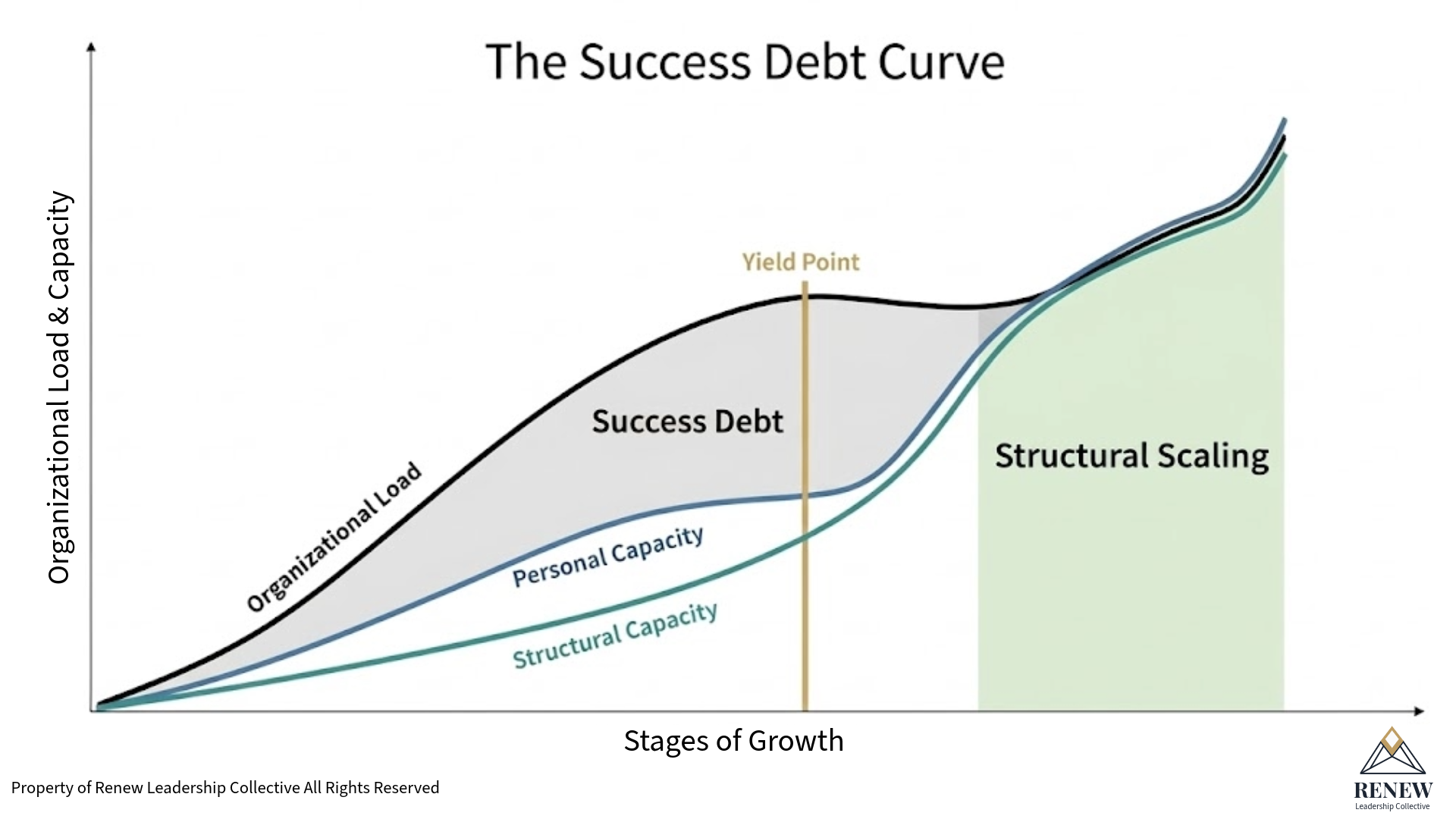
Why what usually works… stops working.
At this stage, most leaders don’t think they have a structural problem.
They think:
“I just need better people.”
“I need to delegate more.”
“I need to be more disciplined.”
“I need to step up as a leader.”
Those responses are logical.
They’ve worked before.
But under increased load, they start to fail.
Because:
Better people still escalate decisions if ownership isn’t clear
Delegation breaks when authority isn’t defined
Discipline increases output—but not capacity
Stepping up often means absorbing even more
So even as you improve…
the system continues to route pressure back to you.
The problem isn’t effort. It’s alignment.
Pressure doesn’t come from lack of effort.
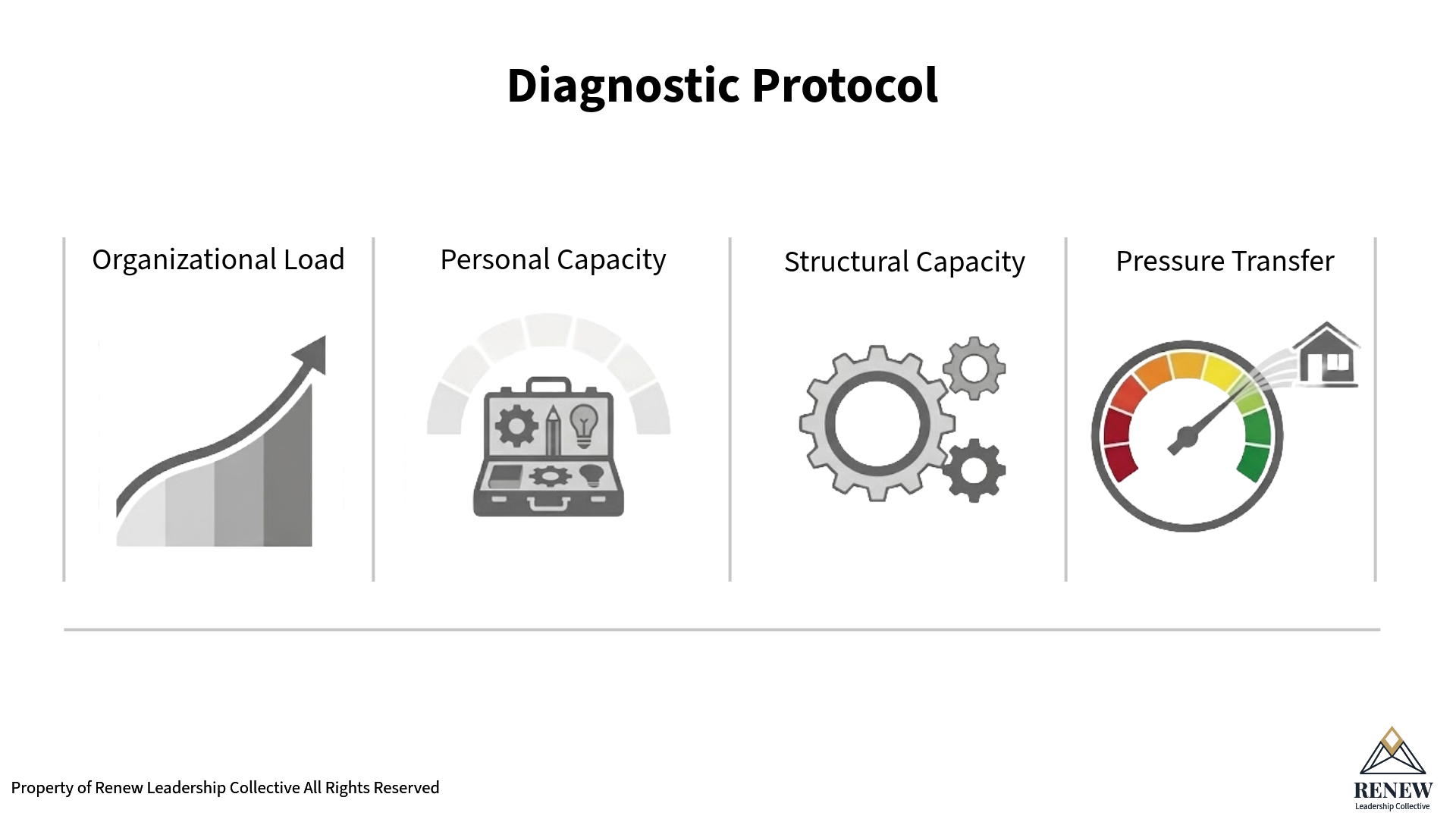
It comes from misalignment between three forces:
Load — the real weight of the organization
Personal Capacity — your ability to carry it
Structural Capacity — the system’s ability to carry it for you
When these are aligned, the system runs.
When they’re not, something has to compensate.
In most organizations, that “something” is the leader.
Not because you’re failing.
Because the structure can’t hold the load without you.
We don’t start by adding more. We start by removing pressure.
You don’t need more strategy right now.
You need room to think again.
Our work follows a three-phase intervention:
We remove pressure immediately.
Decision bottlenecks are cleared.
Ownership is redistributed.
Escalation pathways are reduced.
The system stops relying on you for forward movement.
We stabilize how you operate under load.
With pressure reduced, we rebuild:
clarity
rhythm
decision control
You stop reacting—and start leading again.
We ensure the system can carry the load going forward.
Decision ownership is defined.
Authority is clear.
Accountability holds under pressure.
The system no longer collapses back onto the leader.
The goal of this work is to develop a system that no longer depends on you to function.
ENTRY POINT (SCI-6)
Where most leaders start
For leaders already feeling the pressure, we begin with a focused structural intervention.
Not more theory.
A reset of how the system actually operates.
Relief is not a mindset shift. It’s a structural intervention.
The Process
Audit the Load
Identify where pressure is entering the system.
Map Failure Points
Locate decision bottlenecks and dependency loops.
Transfer Ownership
Move decisions from leader to roles.
Install Constraints
Define authority, limits, and escalation rules.
Reinforce Accountability
Ensure ownership holds under pressure.
Stabilize the System
Lock in new behavior and prevent regression.
Built for leaders carrying real weight.

Jonathan Mayes is a Leadership Capacity Advisor and the architect of the Success Debt framework.
His work focuses on one problem:
When organizations grow beyond the capacity of their structure and the pressure transfers to the leader.
He works directly with a small number of leaders to:
remove structural pressure
restore clarity and control
and build systems that can operate without constant dependence on them
This is not coaching for motivation.
This is structural advisory for leaders who can’t outwork their system anymore.
If everything still depends on you,
it’s not scaling.
You can keep pushing.
You can keep hiring.
You can keep carrying more.
But if the structure hasn’t changed, the outcome won’t either.
At some point, the system forces a correction.
The only question is whether you address it early
or wait until the pressure makes the decision for you.