
ADVISORY FOR CHRISTIAN FOUNDERS, CEOs & SENIOR PASTORS
Get Out of the Weeds.
Get Back to Doing What Only You Can Do.
You built something significant. Now too much of it depends on you.
RLC helps Christian leaders understand what keeps pulling them back into the weeds, then construct a way forward that holds.
Free • Confidential • Personalized voice memo

The Weeds Are Usually Not the Problem.
The questions.
The interruptions.
The decisions.
The fires.
The things only you seem to know how to solve.
Those are what you can see.
But something underneath them keeps pulling you back.
Until you understand what that is, adding another person, another system, another meeting, or another tool may only move the problem around.
What keeps dragging you back into the weeds?

We Don’t Prescribe Before We Understand.
Two leaders can experience the same problem for completely different reasons.
One may need better decision rights. Another may need delegation. Another may need knowledge transferred out of their head. Another may simply be carrying more than their current capacity allows.
We don’t assume the answer before we understand the constraint.
The constraint determines the build.
NOTICE → UNDERSTAND → MOVE
Attention creates the question.
Curiosity creates clarity.
Understanding determines the next move.

THE RLC METHOD
From Stuck to Movement.
01 — AUDIT
Find the signal.
A short assessment helps identify where your capacity may be getting pulled away from what matters most.
02 — MAP
Understand the terrain.
We investigate what is actually happening, what keeps repeating, and where the constraint lives.
03 — BUILD
Construct what movement requires.
The solution might be a system, a decision framework, a delegation structure, a rhythm, a relationship change, or something else entirely.
04 — EMBED
Make it hold.
We observe what happens in the real world, adjust what doesn’t work, and build toward a solution that doesn’t require you to carry it forever.
WHAT WE LOOK FOR
Six Patterns We Keep Seeing.
These aren’t diagnoses. They’re working lenses.
They help us stay curious about the patterns that repeatedly keep capable leaders stuck.
REACTIVITY
What keeps deciding for you?
DEPENDENCE
What keeps coming back to you?
MISALLOCATED ATTENTION
What deserves your attention and what doesn’t?
PERSISTENT OPEN LOOPS
What are you still carrying that should be released?
CAPACITY DEPLETION
What is the cost of continuing this way?
REPEATED REINVENTION
Why are you having to solve this again?
The pattern tells us where to look. The person and the context tell us what is actually happening.

THE OUTCOME
More Capacity. Less Drag.
SPACE IN YOUR MIND
Stop carrying every unresolved question at once.
SPACE ON YOUR CALENDAR
Create room for the work only you can do.
SPACE IN YOUR LIFE
Lead your organization without allowing it to consume everything else.
The goal isn’t an empty calendar.
The goal is having enough capacity to put your attention where it belongs.

THE BLUEPRINT
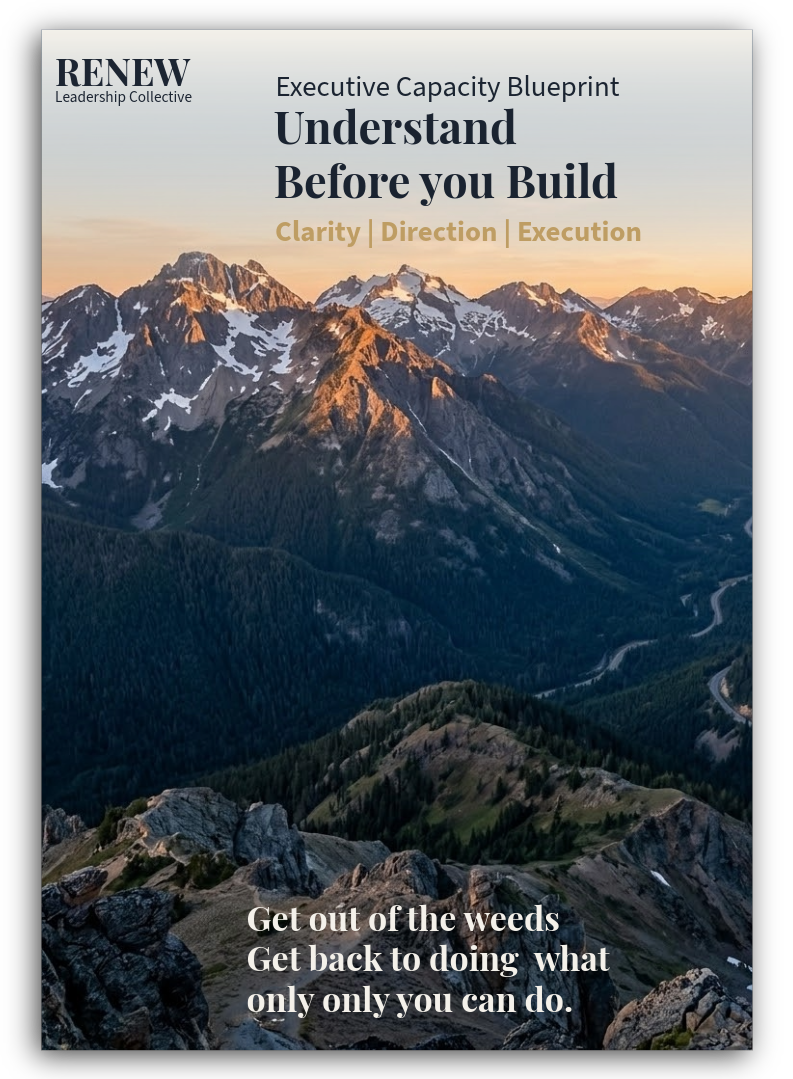
Understand Before You Build.
Executive Capacity Blueprint
The Blueprint moves from signal to understanding.
It answers four questions
But it starts with the audit.
-
What is consuming your capacity?
-
What constraint is creating the problem?
-
What would reduce or remove it?
-
What is the most useful place to begin?
THE BUILD
How Much Do You Want RLC to Carry?
You Decide How Much of the Build You Carry.
Every engagement begins with an Executive Capacity Blueprint
YOU BUILD. WE GUIDE.
You carry implementation. RLC provides direction, structure, and pressure-testing.
WE BUILD IT TOGETHER. RLC
RLC works alongside you to design, build, test, and adjust.
RLC CARRIES THE BUILD.
RLC takes substantial responsibility for designing, building, deploying, and integrating the solution.

ABOUT JONATHAN MAYES

I Don’t Start With Answers.
I Start With Understanding.
I’ve spent much of my career sitting with people in complicated situations first in counseling, then in leadership and organizational work.
One thing kept becoming clearer:
The problem people bring you is not always the problem that needs to be solved.
That’s why I built RLC around a simple principle:
We don’t prescribe before we understand.
My job is to help you understand what is actually keeping you stuck, determine what needs to change, and construct a way forward that holds.
Jonathan Mayes
Founder, Renew Leadership Collective
What's keeping you in the weeds?
Free • Confidential • No commitment
You don’t need to know the answer before you reach out.
Start with the 60-second Executive Capacity Audit. I’ll review your responses and send you a personalized voice memo with what I’m noticing and where I would look next.